
China / Beijing region
The Great Wall
Follow a defensive landscape built and rebuilt across many historical periods.
From the Qin frontier to a Ming pass
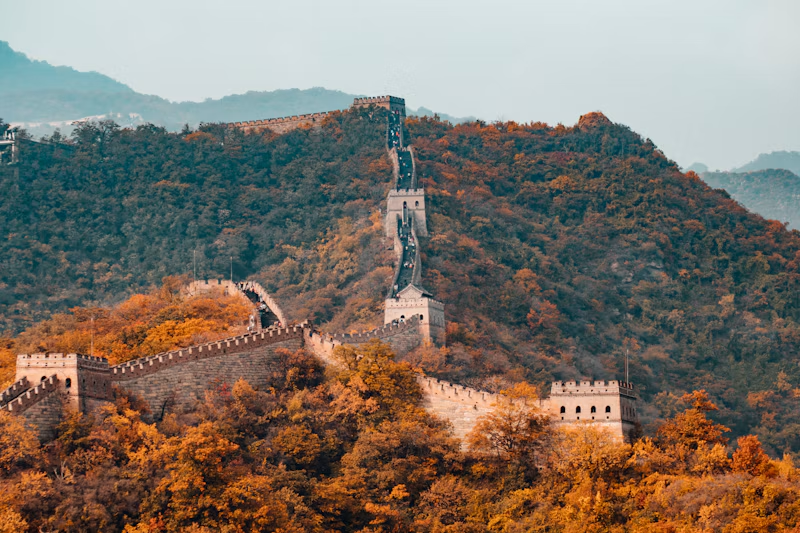
Around 220 BCE, China’s first emperor, Qin Shi Huang, linked walls that earlier states had built along their frontiers. Later rulers added to the system over many centuries. The map pin marks Mutianyu, northeast of Beijing. The towers on this ridge belong to a much later chapter, when the Ming dynasty maintained the approaches to its capital. [1]
Three towers at Zhengguantai
Mutianyu Pass dates to 1404, during the reign of the Yongle emperor. At the pass, Zhengguantai has one wide central tower flanked by two smaller ones. The three connect on both floors. Follow the ridge with your eye to the neighbouring towers, then look back at the mass of masonry concentrated at this single crossing. [2]
Which way do the battlements face?
Along the walkway, look for the regularly spaced gaps in the stonework. At Mutianyu the battlements run down both sides, a distinctive detail on a wall whose other sections often have them on the outer face alone. Looking out through the gaps on each side gives two quite different views of the mountain slopes. [2]
Look for this on site
Find Tower 4 on the map. From a little way along the wall, the separate silhouettes of Zhengguantai’s two smaller towers become easier to pick out.
Before visiting
For Zhengguantai, check the operator’s east route. The eastern lift reaches the area around Tower 6, while the western cable car arrives near Tower 14. Your starting point determines how far you walk to the pass.
Timeline
- c. 220 BCE
- Qin Shi Huang joins stretches of earlier frontier walls.
- 1404
- Mutianyu Pass is built during the Yongle emperor’s reign.
- 1987
- The Great Wall is inscribed on the World Heritage List.