
Cambodia / Siem Reap
Angkor Wat
Discover a temple landscape shaped by devotion, royal ambition and water.
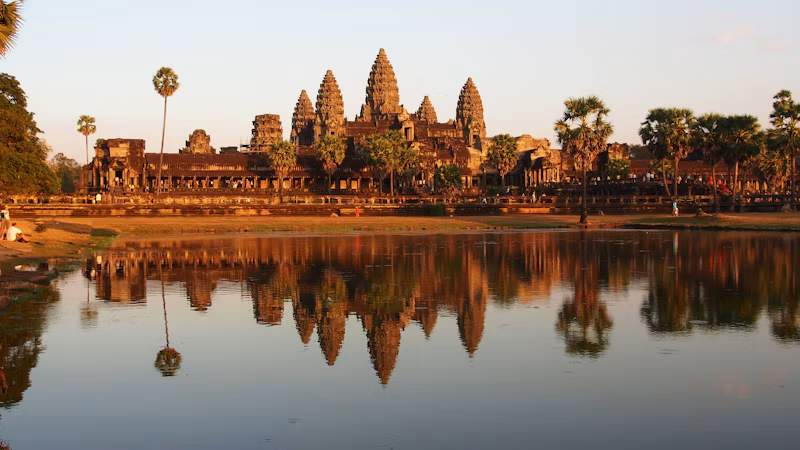
From the moat to the mountain of the gods
Cross the moat from the west and three rectangles of galleries rise one above another. Beyond them four corner towers surround a taller central one. In the early twelfth century, the Khmer king Suryavarman II built the temple for Vishnu. Its ascending levels gave architectural form to Mount Meru, home of the gods in Hindu tradition. Later worshippers made the sanctuary a Buddhist temple. [1]
Follow the serpent along the east gallery
In the southern half of the east gallery, two lines of figures grip a single serpent. In the story carved here, gods and asuras churn an ocean to obtain the elixir of immortality. The serpent serves as a rope wound around a mountain. At the centre, look beneath the mountain for the tortoise, Vishnu in another form, supporting it on his back. That small figure explains how the enormous churn could turn. [2]
The landscape beyond the temple moat
The straight sides of the moat frame this one temple. On a map of the World Heritage site, that rectangle occupies a small part of roughly 400 square kilometres. Successive Khmer capitals left dykes, reservoirs, canals and roads across this landscape. Villages within the park are still inhabited and rice is grown there. Finding the temple first and tracing the waterways beyond it brings a different Angkor into view. [3]
Look for this on site
In the Churning of the Ocean of Milk, trace the serpent from the figures’ hands to the mountain and look below for the tortoise. The connection is easiest to see before examining the faces one by one.
Before visiting
If you approach along the western causeway, mark the southern half of the east gallery on your plan. The relief lies off the direct route to the central sanctuary. As you cross the outer grounds, a view from one side also helps separate the overlapping towers.
Timeline
- Early 12th c.
- During Suryavarman II’s reign in the first half of the twelfth century, Angkor Wat is built for Vishnu.
- 1992
- The wider Angkor site, including Angkor Wat, joins the World Heritage List.