
India / Agra
Taj Mahal
Explore the marble mausoleum created by Shah Jahan in memory of Mumtaz Mahal.
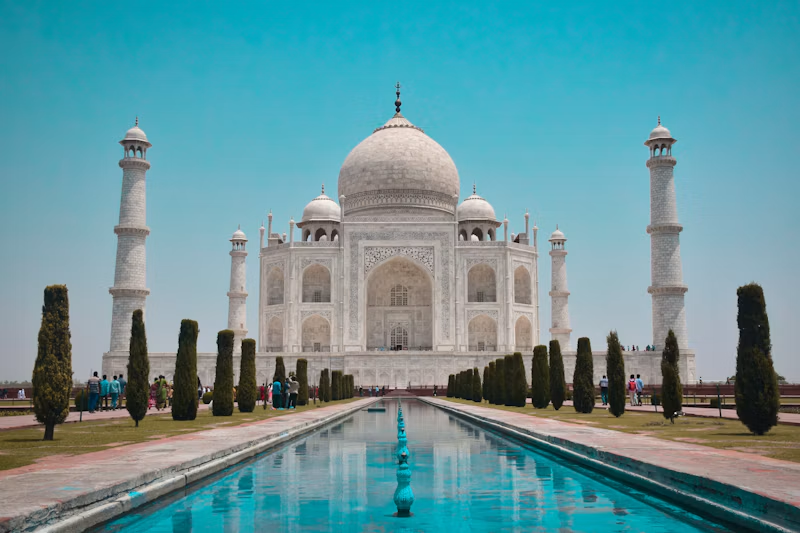
A garden that leads to the river
Through the great southern gateway, a water channel leads the eye toward the mausoleum. A second channel crosses it, dividing the garden into the four quarters of a charbagh. The white tomb stands at the far edge, on a terrace beside the Yamuna. Two red sandstone buildings flank it, a mosque to the west and a guest house to the east. From the crossing of the channels you can see how the riverfront forms the end of the garden’s long axis. [1]
Two ways to make a flower in stone
Along the lower outside walls, stems and petals rise slightly above panels of white marble. Carvers cut back the surrounding stone and polished what remained. The borders carry another kind of flower, assembled from pieces of coloured stone inlaid in the surface. Look for the small shadow under a carved petal, then for the seam around a coloured one. The same subject called for two distinct kinds of craftsmanship. [2]
The two memorials inside the octagon
An octagonal marble screen encloses two cenotaphs in the central chamber. Mumtaz Mahal’s memorial occupies the centre. Shah Jahan, the emperor who commissioned the mausoleum for her, has a larger one added later on its western side. Both burials lie in a chamber below. The line you followed through the garden ends at the memorial of the woman for whom the complex was built. [3]
Look for this on site
Follow the band of calligraphy around an arch. The letters grow slightly larger higher up, compensating for the increasing distance from a viewer on the ground.
Before visiting
Take the central garden path toward the tomb and a side path on the way back. An oblique view separates the corner minarets and brings the red sandstone buildings at either end of the terrace into sight.
Timeline
- 1631
- Mumtaz Mahal dies.
- 1648–1653
- The mausoleum is completed in 1648. Work on the wider complex, including the gateway and mosque, is complete by 1653.
- 1983
- The Taj Mahal is inscribed on the World Heritage List.