
Australia / Sydney
Sydney Opera House
Discover the ambitious modern architecture that transformed Sydney Harbour.
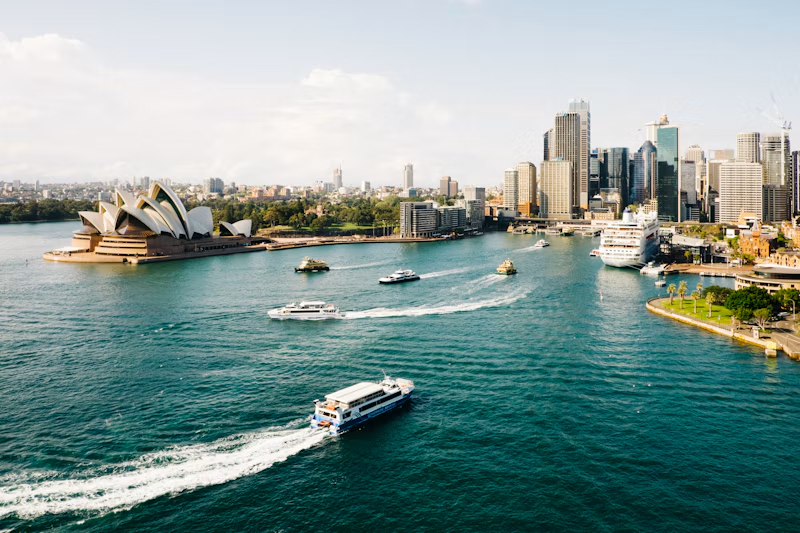
A headland with an older name
The point that carries the Opera House has a history far longer than the building. Known as Tubowgule, it was a place where Aboriginal people gathered long before European settlement. The present name Bennelong Point recalls Woollarawarre Bennelong, a Wangal man. Before looking up at the shells, follow the shape of the headland itself where it reaches into the harbour. [1]
One sphere, many roofs
The roofs look different in size and tilt from across the water. Building each as a separate curved form posed a formidable problem. Jørn Utzon and his collaborators derived them from sections of the same sphere. That shared curvature made repeated structural components possible. Try following two different roof edges with your eyes and imagining each as an arc drawn on one enormous ball. [2]
A stage at the scale of the harbour
Approach the building on foot and the broad podium becomes as noticeable as the roof. The World Heritage description treats its platform and surrounding pedestrian terraces as part of the design. From the water the whole structure reads as a sculpture. From the steps it becomes a landscape that guides people towards different doors. [3]
Look for this on site
Compare the balance of roof and podium from across the water and from the foot of the steps. The second view reveals the depth of the base that almost disappears in a harbour photograph.
Before visiting
The forecourt, tours and performance tickets provide different experiences. Check the venue’s visitor information for the entrance used by your tour or performance.
Timeline
- 1957
- Utzon wins the international design competition.
- 1973
- The Opera House opens.
- 2007
- The building enters the World Heritage List.