
Egypt / Giza
Pyramids of Giza
Encounter monumental royal tombs on a plateau above the Nile valley.
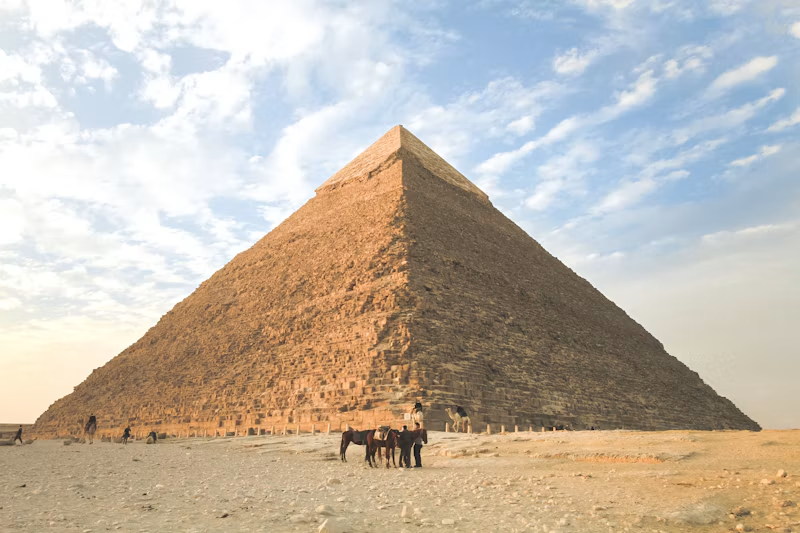
Look beyond the peaks
The pyramids of Khufu, Khafre and Menkaure rise above a plateau full of other structures. A king’s pyramid belonged to a funerary complex with temples and a connecting causeway. Members of the royal family and other officials were buried nearby. Follow those horizontal links with your eyes after taking in the three triangular silhouettes. [1]
Stone that travelled to Giza
Khufu’s builders used local limestone for much of the Great Pyramid. A finer stone once faced the exterior. Egypt’s Ministry of Tourism and Antiquities describes this casing stone arriving by boat from Tura. The rough courses that are so striking today tell only part of the story. Picture the separate tasks of quarrying, transport and fitting a smooth outer face. [2]
Read the ground below Khafre
Khafre built on slightly higher ground than his father Khufu. From some viewpoints the second pyramid can look as tall as the first. Compare the two bases before comparing their peaks. A small change in where you stand reveals the part played by the plateau itself. [3]
Look for this on site
On a site plan, trace the causeway from the mortuary temple at Khafre’s pyramid down towards the valley temple. Then look for the direction of the slope on the ground.
Before visiting
Plateau admission and entry to pyramid interiors may require different tickets. Check the ministry listing for the particular pyramid you wish to enter.
Timeline
- 26th c. BCE
- The Great Pyramid is built for Khufu of the Fourth Dynasty.
- 1979
- The pyramid fields, including Giza, enter the World Heritage List.